
-
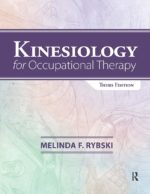
Kinesiology for Occupational Therapy 3rd Edition by Melinda F. Rybski (Author)
Kinesiology for Occupational Therapy, Third Edition covers the theoretical background for understanding the kinematics and kinetics of normal human physiological movement. Each specific joint is assessed in terms of musculoskeletal function, movements possible, and an overview of pathology that may develop. Dr. Melinda Rybski covers four occupational therapy theories related to functional motion that are important for occupational therapists to know. This Third Edition has been updated to reflect the current field and includes new information that has emerged in recent years.
New in the Third Edition:
Content closely follows AOTA’s Occupational Therapy Practice Framework and Occupational Therapy Vision 2025
Updated and more extensive provision of evidence that summarizes key findings in current literature
New theories are presented in the Intervention sections
Extensive, joint specific and theory-based assessments are provided
Interventions described are occupation-based, process-based
Kinesiology concepts presented in a practical, useable way
Expanded chapters for Spine and Thorax and Hip and Pelvis.
Included with the text are online supplemental materials for faculty use in the classroom.Kinesiology for Occupational Therapy, Third Edition clearly outlines the need for an understanding of kinesiology in occupational therapy, providing occupational therapists with the evidence necessary to support their intervention strategies.
-
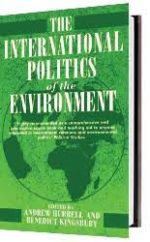
The international politics of the environment
KSh 1,000.00Environment is now a key component of international relations and, given the rising attention climate change receives in particular (Welzer, 2012), a matter that now has high priority in diplomatic circles. With states in danger of disappearing below rising seas and major disruptions to water supplies and food systems projected for future decades if steps to curb greenhouse gas emissions are not taken soon, environmental matters have become central to contemporary international politics, and to their academic study (Webersik, 2010). Environment emerged after the Cold War as a priority matter for scholarly analysis because scholars are concerned with matters of pollution, conservation and resources; but also because there are interesting analytical puzzles surrounding how the international system deals with them and the changes resulting from the introduction of new modes of governance, institutions, agencies, knowledge and norms.
-
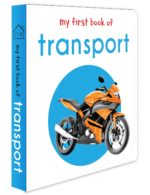
My First Book of Transport
KSh 395.00The perfect first picture board book for your child to learn about transport. Well researched pictures will help your baby to identify means of transport, build vocabulary and improve observation skills.
-
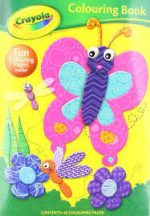
CRAYOLA COLOURING BOOK BUTTERFLY
KSh 495.00Crayola Colouring Book Butterfly has 48 fun colouring pages for children to complete. With fun designs children can imagine and colour as they want. Each Page has a unique design that allow children to express their imaginative abilities
-

spotlight integrated science grade 9
KSh 815.00It is a learner’s book built for Grade 9 under the current Competency-Based Curriculum (CBC) in Kenya.
It’s meant to give a broad, foundational introduction to science — not just one branch (like biology or physics), but an integrated survey across multiple disciplines: biology, chemistry, physics, and health science.
🎯 Purpose & Educational Approach
The book aims to:
Help learners build scientific knowledge, problem-solving skills, and scientific literacy that they can apply in everyday life and future studies.
Encourage inquiry-based learning (asking questions, doing experiments, observing results, analyzing) — not just memorizing facts.
Promote critical thinking, creativity, and innovation, by having learners do experiments, investigations, projects, and real-life application tasks.
Integrate cross-cutting themes beyond science: environmental awareness, ICT (digital literacy), and even entrepreneurship, linking science to real-world contexts.
Offer a learner-friendly format: explanations illustrated with diagrams, charts, and photographs; plus a mix of class activities, homework projects, and self-assessment exercises.
✏️ What’s Inside — Typical Topics & Structure
While topics may vary slightly by syllabus edition, typical content includes:
Living things and their environment — nutrition in plants, photosynthesis, reproduction in plants, seed/fruit dispersal, ecology, energy flow, food chains/webs.
Basic biology and ecosystems — classification of organisms, interdependence of life, symbiosis, parasitism, saprophytism.
Fundamental chemistry — matter, mixtures, chemical reactions, maybe periodic table and basic chemical concepts (though detailed chemistry comes later). The integrated design means chemistry is introduced alongside biology and physics.
Basic physics/physical science — energy, matter, possibly concepts related to physical phenomena and forces (since Integrated Science spans physical world understanding).
Health science and everyday science applications — hygiene, sanitation, nutrition, environmental conservation, and using science knowledge for real-life wellbeing and sustainability.
Each section tends to include: explanations + illustrations, practical experiments or investigations, group work or project work, self-assessment or class assessment tasks.
📈 Why It Matters
It lays the foundation for STEM pathways at senior school level — giving learners strong grounding before they specialize.
It fosters a scientific mindset: curiosity, critical thinking, problem-solving, and evidence-based decision making — useful beyond school, in everyday life.
By integrating ICT, environment and entrepreneurship themes, it bridges school science with real-world challenges — preparing learners to apply science creatively and responsibly.
-
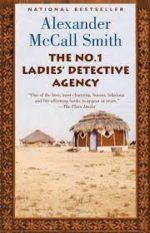
The No. 1 Ladies’ Detective Agency
KSh 650.00This first novel in Alexander McCall Smith’s widely acclaimed The No. 1 Ladies Detective Agency series tells the story of the delightfully cunning and enormously engaging Precious Ramotswe, who is drawn to her profession to “help people with problems in their lives.” Immediately upon setting up shop in a small storefront in Gaborone, she is hired to track down a missing husband, uncover a con man, and follow a wayward daughter. But the case that tugs at her heart, and lands her in danger, is a missing eleven-year-old boy, who may have been snatched by witchdoctors.
The No. 1 Ladies’ Detective Agency received two Booker Judges’ Special Recommendations and was voted one of the International Books of the Year and the Millennium by the Times Literary Supplement.
-
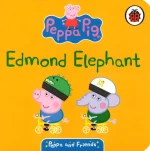
Peppa & Friends: Edmond Elephant
KSh 495.00Are you looking for a book that your child will love to learn from? Grab yourself a copy of Peppa & Friends Edmond Elephant Book from Peppa Pig. This small board book comes full of Peppa Pig characters your child will recognise and an easy to read font that you can use to read along with your child as they enjoy a story with Peppa Pig and her friends. George loves playing with his friend Edmond Elephant. Edmond is very clever and knows lots of things!
-

Cases and Materials on Insurance Law
KSh 34,760.00This Ninth Edition contains extensive updates, with new cases relevant for students anxious to acquire practical knowledge that can be quickly put to use when they enter the profession.
-
Textbook Of Community Medicine Preventive And Social Medicine 8Ed
KSh 4,000.00The book is a comprehensive textbook on community medicine / preventive & social medicine, written by Sunder Lal, Adarsh & Pankaj — designed for MBBS / undergraduate medical students.
aibh.inIt is the 8th edition, revised and updated to align with the latest competency-based undergraduate curriculum for Indian medical graduates as mandated by the national regulatory authority.
It presents 20 thoroughly revised and updated chapters and addresses 107 core competencies with special emphasis on 18 skill-based competencies. In addition, the seventh edition incorporates attitude, ethics, and communication (AETCOM) skills (soft skills) to be integrated into undergraduate curriculum.★ The revised chapters on concept of health and disease, ethics in medicine and doctor–patient relationship, social and behavioural sciences (humanities), principles of health promotion and eduction, counselling and social marketing, health care of community and community diagnosis, gender issues and women empowerment, health care delivery systems, health planning and management, laws pertaining to practice of medicine, focus on: “real life issues” as illustrated in Problem based Learning, various case studies, building communication skills, eliciting health care seeking behaviours, barriers in health care, doctor—patient and community relationship, communication needs, assessment of comprehensive community diagnosis, therapy and prognosis, role of physician in health care system and responsibility to society and community, working in a health care team as leader and member of health team, health legislations pertaining to practice of medicine in outbreak and pandemic situation.All the chapters focus on “Community as Patient”, community diagnosis and community therapy. Whole of the government and whole of the socie
-
Forensic Pathology Principles and Practice
KSh 60,000.00Forensic Pathology is a comprehensive reference that uses a case-oriented format to address, explain and guide the reader through the varied topics encountered by forensic pathologists. Developed in response to a severe void in the literature, the book addresses topics ranging from medicolegal investigation of death to death scene investigation, forensic autopsy, and artifacts of resuscitation as well as complications of medical therapy, forensic osteology, forensic odontology, forensic photography, and death certification. The book includes various types of cases, including sudden natural death, asphyxia, motor vehicle collisions, death in custody, child abuse and elder abuse, acute psychiatric and emotional deaths, and pregnancy. It contains sample descriptions of pathological lesions which serve to aid pathologists in reporting their findings to law enforcement agencies, attorneys, and others involved in investigations of sudden death. The concepts outlined in the text are beautifully illustrated by large, colorful photographs. There are also “Do and Don’t” sections at the end of each chapter that provide guidance for handling the types of cases examined. This work will benefit not only experienced forensic pathologists, but also hospital pathologists who occasionally performs medicolegal autopsies; doctors in training; medical examiners; law enforcement personnel; crime scene investigators; attorneys; and fellows and students of the medical sciences.