
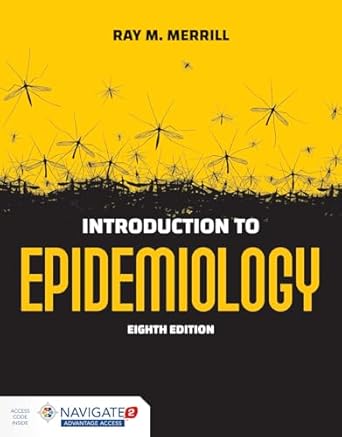
Recognized by Book Authority as one of the best Public Health books of all time, Introduction to Epidemiology is a comprehensive, reader-friendly introduction to this exciting field. Designed for students with minimal training in the biomedical sciences and statistics, this full-color text emphasizes the application of the basic principles of epidemiology according to person, place, and time factors in order to solve current, often unexpected, and serious public health problems.Students will learn how to identify and describe public health problems, formulate research hypotheses, select appropriate research study designs, manage and analyze epidemiologic data, interpret and apply results in preventing and controlling disease and health-related events. With real-world examples in the form of case studies and news files in each chapter, Introduction to Epidemiology is an accessible and effective approach to learning epidemiology.The Eighth Edition features:- Same organization as the prior edition allowing for easier transition- New or expanded coverage of the models of causation, methods of age adjustment, age-period cohort models, incubation and latency periods, and receiver operating characteristic (ROC) curves- Clearer connection between statistical inference and causal inference- New and updated practical examples and News Files help solidify concepts and show real-world application- Updated tables and figures throughout- Access to Navigate 2 online learning materials, including a comprehensive and interactive eBook, student practice activities and assessments, learning analytics reporting tools, and more- A built-in adaptive learning feature enables students to take self-assessments before or after reading a chapter. Based on their performance they can map out their own custom study plan that directs them to the areas of the text to review.
Introduction to Epidemiology
KSh 4,820.00
Recognized by Book Authority as one of the best Public Health books of all time, Introduction to Epidemiology is a comprehensive, reader-friendly introduction to this exciting field. Designed for students with minimal training in the biomedical sciences and statistics, this full-color text emphasizes the application of the basic principles of epidemiology according to person, place, and time factors in order to solve current, often unexpected, and serious public health problems.Students will learn how to identify and describe public health problems, formulate research hypotheses, select appropriate research study designs, manage and analyze epidemiologic data, interpret and apply results in preventing and controlling disease and health-related events. With real-world examples in the form of case studies and news files in each chapter, Introduction to Epidemiology is an accessible and effective approach to learning epidemiology.The Eighth Edition features:- Same organization as the prior edition allowing for easier transition- New or expanded coverage of the models of causation, methods of age adjustment, age-period cohort models, incubation and latency periods, and receiver operating characteristic (ROC) curves- Clearer connection between statistical inference and causal inference- New and updated practical examples and News Files help solidify concepts and show real-world application- Updated tables and figures throughout- Access to Navigate 2 online learning materials, including a comprehensive and interactive eBook, student practice activities and assessments, learning analytics reporting tools, and more- A built-in adaptive learning feature enables students to take self-assessments before or after reading a chapter. Based on their performance they can map out their own custom study plan that directs them to the areas of the text to review.
2 in stock
Customer Reviews
There are no reviews yet.
Related products
-

Robbins & Cotran Pathologic Basis of Disease, 10th Edition
KSh 18,480.00Readable and highly illustrated, Robbins and Cotran Pathologic Basis of Disease, 10th Edition presents an in-depth, state-of-the-art overview of human diseases and their cellular and molecular basis. This best-selling text delivers the latest, most essential pathology knowledge in a readable, interesting manner, ensuring optimal understanding of the latest basic science and clinical content. More than 1,000 high-quality photographs and full-color illustrations highlight new information in molecular biology, disease classifications, new drugs and drug therapies, and much more. This superb learning package also includes an enhanced eBook with a full complement of ancillary content on Student Consult
-
Medical Microbiology, International Edition, 19th Edition
KSh 7,462.00Medical microbiology concerns the nature, distribution and activities of microbes and their impact on health and wellbeing. In spite of the introduction of many antimicrobial agents and immunisations, we continue to face major challenges in combatting infection, not least the gathering crisis in antimicrobial resistance.
Now in a fully revised and updated 19th edition, Medical Microbiology provides comprehensive coverage of infection from the microbial perspective, combining a clear introduction to key principles with a focus explicitly geared to modern clinical practice. It provides ideal coverage for medical and biomedical students – with ‘Key Points’ boxes throughout to highlight the essentials – and sufficient detail to also inform specialists in training.
Building on the success of previous editions, updates in Medical Microbiology 19e include:
-
- New and expanded coverage of hot topics and emerging areas important to clinical practice, including:
-
-
- Genomics
-
-
-
- The Human Microbiome
-
-
-
- Direct acting antiviral agents for the treatment of HCV infection
-
-
-
- Molecular methods in diagnostic microbiology
-
-
-
- Antibiotic Stewardship
-
-
- BONUS electronic materials to enhance your learning, including:
-
-
- Clinical cases – to introduce how patients with infections present and help relate key principles to practice
-
-
- MCQs for each chapter – to check understanding and aid exam preparation
-
-
Netter’s Clinical Skills, 1st Edition
KSh 3,080.00Make the most of every patient encounter – from the clinical interview and history to the physical exam, both in-office and bedside. This discreet quick reference by Ilene L. Rosenberg, MD, FCCP, Todd Cassese, MD, FACP, and Dennis Barbon, RN, helps you achieve consistent and comprehensive results when collecting data and determining your next steps. Carry this thin, fully illustrated checklist in your white coat pocket for the fastest, most efficient way to access essential information you need to know and remember every day.
-

Davidson’s Principles and Practice of Medicine, 24th Edition(paperback)
KSh 10,640.00Well over two million medical students, doctors and other health professionals around the globe have owned a copy of Davidson’s Principles and Practice of Medicine since it was first published over 70 years ago. Now in its 24th Edition, this thoroughly updated textbook describes the pathophysiology and clinical features of the most frequently encountered conditions in the major specialties of adult medicine, and explains how to recognise, investigate, diagnose and manage them. Taking its origins from Sir Stanley Davidson’s much-admired lecture notes, Davidson’s has endured because it keeps pace with how modern medicine is taught and provides a wealth of trusted information in an easy-to-read, concise and beautifully illustrated format.
Key features:
-
- Part 1 ‘Fundamentals of Medicine’ – provides an account of the principles of genetics, immunology, infectious diseases, population health, oncology and pain management, along with a discussion of the core principles behind clinical decision-making and good prescribing.
-
- Part 2 ‘Emergency and Critical Care Medicine’ – covers medical emergencies in poisoning, envenomation and medicine in austere environments, as well as common presentations in acute medicine and the recognition and management of the critically ill.
-
- Part 3 ‘Clinical Medicine’– covers the major medical specialties, each thoroughly revised and brought fully up to date. A new section on COVID-19 has been added and the impact of this infection is described throughout the book.
-
- Clinical Examination overviews – extended and updated to summarise the main elements for each system.
-
- Presenting Problems sections – provide a clear pathway for the assessment of and approach to the most common complaints in each specialty.
-
- Practice Point summaries – detail the practical skills that medical students and junior doctors must acquire.
-
- Emergency boxes – emphasise the core knowledge needed to manage acutely ill patients.
-
- In Old Age, In Pregnancy and In Adolescence boxes – highlight differences in the practice of medicine in these patient groups, and illustrate the interfaces between medical, obstetric and paediatric services.
-
- The text is extensively illustrated – with over 1000 diagrams, clinical photographs, and radiology and pathology images.
- The global perspective is enhanced by an International Advisory Board of experts from 11 countries and by leading authors from around the world.
-
-

Management Principles for Health Professionals
KSh 7,420.00Management Principles for Health Professionals is a practical guide for new or future practicing healthcare managers. The customary activities of the manager―planning, organizing, decision making, staffing, motivating, and budgeting―are succinctly defined, explained, and presented with detailed examples drawn from a variety of health care settings. Students will learn proven management concepts, techniques, models, and tools for managing individuals or teams with skill and ease.The Eighth Edition continues to present foundational principles of management in the context of contemporary health care. With timely coverage of such topics as medical cost sharing; use of robots; ER by appointment; increased use of observation units; renewed use of flextime staffing and scheduling; use of social media on the job, and more, this thoroughly updated text addresses the latest trends and issues that today’s health care manager is likely to encounter.Key Features- Presents 2 new tools ―The Manager’s Wheel Book and the Management Reference Portfolio ― to help new managers better understand their role and responsibilities and to aid existing managers in understanding their organization in detail- Covers managing care in a wide variety of health care settings (urgent care centers, specialty clinics, home care, etc.) outside of the traditional hospital setting.- Addresses technology and its impact, including eVisits/telemedicine, implementation of electronic health records, connectivity and the expectation that workers will respond during off hours via email and instant messaging, etc. – Offers expanded coverage on the importance and impact of corporate culture, the values of transparency and accountability, leadership style, and competitiveness.- Includes detailed examples of reports, plans, directives, union contracts, and more.
-

Oxford Handbook of Clinical Specialties (Oxford Medical Handbooks
KSh 6,580.00Now in its 25th year, the Oxford Handbook of Clinical Specialties has been revised and updated by a trusted author team to bring you practical, up-to-date clinical advice and a unique outlook on the practice of medicine. Twelve books in one, this is the ultimate guide to the core clinical
specialties for students, junior doctors, and specialists.This edition features a new and improved referencing system guided by a team of junior doctors, ensuring that the text is packed with valuable references to the most salient data and guidelines across the specialties. Each chapter has been updated on the advice of a team of specialists, to bring you
everything you need for any eventuality on the ward or in the field. This essential handbook guides the reader through the management of an unprecedented spectrum of conditions and eventualties, from sexual health to major incident management. Compact and filled with high quality artwork, directions
to further reading, and wise advice, this book is an ideal resource for revision and reference on the go.With its companion volume, the Oxford Handbook of Clinical Medicine, the Oxford Handbook of Clinical Specialties offers a unique perspective on the practice of medicine. Filled with wit, wisdom, and humanity, this book draws on literature, history, and personal experience to teach a philosophy of
medicine that always puts the patient at the centre of compassionate care. It is a trustworthy companion for anyone with the spirit of self-improvement and a passion for their practice. -

Management Principles for Health Professionals
KSh 7,420.00Management Principles for Health Professionals is a practical guide for new or future practicing healthcare managers. The customary activities of the manager―planning, organizing, decision making, staffing, motivating, and budgeting―are succinctly defined, explained, and presented with detailed examples drawn from a variety of health care settings. Students will learn proven management concepts, techniques, models, and tools for managing individuals or teams with skill and ease. The Eighth Edition continues to present foundational principles of management in the context of contemporary health care. With timely coverage of such topics as medical cost sharing; use of robots; ER by appointment; increased use of observation units; renewed use of flextime staffing and scheduling; use of social media on the job, and more, this thoroughly updated text addresses the latest trends and issues that today’s health care manager is likely to encounter. Key Features – Presents 2 new tools ―The Manager’s Wheel Book and the Management Reference Portfolio ― to help new managers better understand their role and responsibilities and to aid existing managers in understanding their organization in detail – Covers managing care in a wide variety of health care settings (urgent care centers, specialty clinics, home care, etc.) outside of the traditional hospital setting. – Addresses technology and its impact, including eVisits/telemedicine, implementation of electronic health records, connectivity and the expectation that workers will respond during off hours via email and instant messaging, etc. – Offers expanded coverage on the importance and impact of corporate culture, the values of transparency and accountability, leadership style, and competitiveness. – Includes detailed examples of reports, plans, directives, union contracts, and more.
-
Clinical Examination Essentials An Introduction to Clinical Skills (and how to pass your clinical exams)
KSh 7,000.00Talley and O’Connor’s Clinical Examination Essentials 5e provides an introduction to the skills required to successfully pass your clinical exams.
It offers tips on how to impress your examiners and highlights key steps in taking a history and conducting a physical examination. With practice these will become second nature, even under the stress of exam conditions.
We hope that Talley and O’Connor’s Clinical Examination Essentials inspires you to master your clinical skills and embark on a successful medical career. If you are looking to further develop your history taking and examination techniques, Talley and O’Connor’s Clinical Examination: A Systematic Guide to Physical Diagnosis provides greater detail
Be the first to review “Introduction to Epidemiology”