
The use of simulation models is a necessity and also an aid in the decision-making process in sustainable agricultural systems. Organizing the experimental knowledge of crop production systems without the book keeping and deductive methods of mathematics is very difficult. This book aims to guide readers in the process by which the properties of the systems can be grasped in the framework of mathematical structure with minimal mathematical prerequisites. The objective of this book is to help the undergraduate, graduate and post-graduate students in the disciplines of agronomy, plant breeding, agricultural meteorology, crop physiology, agricultural economics, entomology, plant pathology, soil science and ecology (environmental science). This book may also be useful for administrators in various agricultural universities in order to direct research, extension and teaching activities. Planners at national and state levels may also benefit from this book
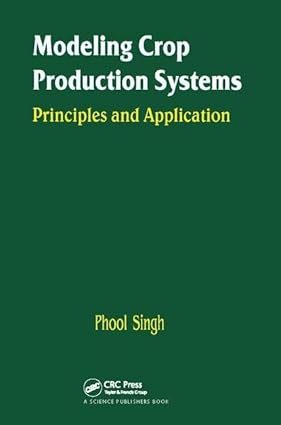
Modeling Crop Production Systems: Principles and Application 1st Edition by P Singh (Author)
KSh 5,800.00
The use of simulation models is a necessity and also an aid in the decision-making process in sustainable agricultural systems. Organizing the experimental knowledge of crop production systems without the book keeping and deductive methods of mathematics is very difficult. This book aims to guide readers in the process by which the properties of the systems can be grasped in the framework of mathematical structure with minimal mathematical prerequisites. The objective of this book is to help the undergraduate, graduate and post-graduate students in the disciplines of agronomy, plant breeding, agricultural meteorology, crop physiology, agricultural economics, entomology, plant pathology, soil science and ecology (environmental science). This book may also be useful for administrators in various agricultural universities in order to direct research, extension and teaching activities. Planners at national and state levels may also benefit from this book
2 in stock
Customer Reviews
There are no reviews yet.
Related products
-
Machine Learning A Practical Approach on the Statistical Learning Theory
KSh 19,000.00This book presents the Statistical Learning Theory in a detailed and easy to understand way, by using practical examples, algorithms and source codes. It can be used as a textbook in graduation or undergraduation courses, for self-learners, or as reference with respect to the main theoretical concepts of Machine Learning. Fundamental concepts of Linear Algebra and Optimization applied to Machine Learning are provided, as well as source codes in R, making the book as self-contained as possible.
It starts with an introduction to Machine Learning concepts and algorithms such as the Perceptron, Multilayer Perceptron and the Distance-Weighted Nearest Neighbors with examples, in order to provide the necessary foundation so the reader is able to understand the Bias-Variance Dilemma, which is the central point of the Statistical Learning Theory.
Afterwards, we introduce all assumptions and formalize the Statistical Learning Theory, allowing the practical study of different classification algorithms. Then, we proceed with concentration inequalities until arriving to the Generalization and the Large-Margin bounds, providing the main motivations for the Support Vector Machines.
From that, we introduce all necessary optimization concepts related to the implementation of Support Vector Machines. To provide a next stage of development, the book finishes with a discussion on SVM kernels as a way and motivation to study data spaces and improve classification results.
-

Environmental Engineering Paperback – 14 July 2017
KSh 7,500.00The book covers the important aspects of water, air and noise pollution. Using a multidisciplinary approach, it highlights the impact of environmental pollution in the world. It also suggests methods for controlling and scientific monitoring of pollution-causing agents. Also included are chapters on efficient guidelines and standards, radioactive waste, solid waste disposal and sewage treatment, oil pollution and role of insecticides. Pollution in tanneries, fertilizer industry, and pulp and paper industries is also covered. The last few chapters are devoted to environmental management, benefit-cost analysis and mathematical modelling for environmental pollution control.
-

Handbook of Vegetable Science and Technology
KSh 10,200.00“Furnishes exhaustive, single-source coverage of the production and postharvest technology of more than 70 major and minor vegetables grown in tropical, subtropical, and temperate regions throughout the world. Provides comparative data for each vegetable presented. “
-

Agricultural Marketing and Price Analysis
KSh 9,330.00Norwood and Lusk provide a fresh approach to marketing and price analysis that speaks to undergraduate students. In addition to providing thorough coverage of core topics, they address exciting developments and emerging areas of research in the field. Friendly and engaging, Agricultural Marketing and Price Analysis presents a comprehensive approach to agricultural price analysis, agricultural market structures, and agricultural marketing strategies.
Unique to this book is the inclusion of the equilibrium displacement model and a chapter on consumer behavior and research. The Meet the Professional feature illustrates how the economic principles covered fit into the careers students will soon enter. End-of-chapter crossword puzzles and study questions assist in learning terminology and test preparation. Succinct and approachable, this text sets the stage for an enjoyable and effective learning experience.
-

Disaster Management, Corporate Social Responsibility and Conservation Issues
The vulnerability of various regions of the world towards disasters, both natural and anthropogenic, is widely known. Disasters such as landslides, earthquakes, floods have a long-lasting effect on the environment and socio-economic systems. These disasters have been occurring at regular intervals of time and the economic and social cost of these mount every year.
Disaster Management, Corporate Social Responsibility, and Conservation Issues deals with the fundamental principles and current practices in the field of disasters. The book covers various environmental challenges and issues related to natural disasters that affect all forms of life. It discusses how disasters can be managed and the role corporate social responsibility can play in addressing the issues. The book also provides conservation steps that can help in mitigating disasters. Experts from different fields have contributed diverse, technical, and best concepts. Through the writings, the book will make readers better prepared for the challenges of disaster management and strive towards sustainable development.
Contents:
- A Review of Flood Disaster in Assam State of India: Causes and Impacts
- Rampant Tourism an Ecological Disaster in Waiting: Case study from Ladakh
- A Retrospective Analysis of Earthquake Hazards and Hydropower Development in Indian Himalayan Region
- Factors Causing Landslides and Importance of Parameters during Landslide Hazard Zonation: Experiences from Kumaun Himalayas
- Major Natural Disasters and Livelihoods Improvement of Disaster-affected Areas through Horticulture in Uttarakhand
- Effects of Climate Change on Agriculture: Indian Perspective
- Potentially Important but Neglected Roadside and Wasteland Medicinal Plants of Uttarakhand
- Natural disasters in hilly areas: special reference to people living in Indian Himalayan Region
- Ambient air pollution and its sources in the semi-rural sites in the Northwestern Indian Himalayas
- Diversity analysis, indigenous uses and current status of medicinal plants in Mohalkhad Watershed of Himachal Pradesh, Northwestern Himalayas
- Site occupancy and abundance of sloth bear in southern Aravalli Hills, India
- Managing disaster through Corporate Social Responsibility and sustainability-based project on apple management in Himachal Pradesh leading to sustainable development
- Community Participation in Disaster Management: Case studies from Uttarakhand
- Commentary on evolution and divergence of the concept of CSR and recent developments laid by Companies Act 2013
-

Calculus: A New Horizon
KSh 3,500.00calculus is aimed at future engineers and professional scientists. Applications modules at the ends of chapters demonstrate the need to relate theoretical mathematical concepts to real world examples. These modules examine problem-solving as it occurs in industry or research settings, such as the use of wavelets in music and voice synthesis and in FBI fingerprint analysis and storage.
-

Linear Algebra
KSh 7,500.00Linear algebra
The development of the internationally standardized language ALGOL has made it possible to prepare procedures which can be used without modification whenever a computer with an ALGOL translator is available. Volume Ia in this series gave details of the restricted version of ALGOL which is to be employed throughout the Handbook, and volume Ib described its implementation on a computer. Each of the subsequent volumes will be devoted to a presentation of the basic algorithms in some specific areas of numerical analysis. This is the first such volume and it was feIt that the topic Linear Algebra was a natural choice, since the relevant algorithms are perhaps the most widely used in numerical analysis and have the advantage of forming a weil defined dass. The algorithms described here fall into two main categories, associated with the solution of linear systems and the algebraic eigenvalue problem respectively and each set is preceded by an introductory chapter giving a comparative assessment. -

Agricultural and Agribusiness Law An Introduction for Non-Lawyers
KSh 8,330.00This introductory textbook provides an overview of the concepts necessary for an understanding of agricultural and agribusiness law. The text will help students of land-based industries with little or no legal background to appreciate and identify issues that may require referral or consultation with legal counsel. This new edition is fully revised and updated, particularly addressing developments in taxation and trade, and includes a new chapter on criminal law, an area of increasing relevance to agriculture.
Each concise chapter addresses a different legal issue that those employed in agriculture and agribusiness may face, and both federal law and representative examples of state law are included. In addition to traditional topics such as contracts, property law, and estate planning, the book also covers more contemporary issues such as organic certification, animal law, genetically engineered crops, and food safety.
Agricultural law extends beyond those directly engaged in farming to those in agribusiness who provide services and inputs to farmers, buy farmers’ products, store or transport products, manufacture food products and serve as intermediaries between farmers and consumers. The book will, therefore, also serve as a reference and a guide for those employed in agribusiness and agriculture.
Be the first to review “Modeling Crop Production Systems: Principles and Application 1st Edition by P Singh (Author)”