
This is the scandalous story of how the Maasai people of Kenya lost the best part of their land to the British in the 1900s. Drawing upon unique oral testimony and extensive archival research, Hughes describes the intrigues surrounding two enforced moves and the 1913 lawsuit, while explaining why recent events have brought the story full circle.
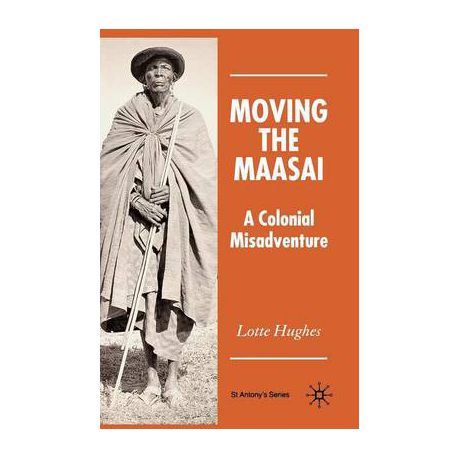
Moving the Maasai: A Colonial Misadventure (St Antony’s Series) 1st ed. 2006 Edition
KSh 15,260.00
1 in stock
| Author | L. Hughes |
|---|
Customer Reviews
There are no reviews yet.
Related products
-

Into Africa: The Epic Adventures Of Stanley And Livingstone by MARTIN DUGARD
KSh 2,000.00A gripping retelling of the legendary story of Livingstone and Stanley.
In 1866 Britain’s foremost explorer, Dr David Livingstone, went in search of the answer to an age- old geographical riddle- where was the source of the Nile? Livingstone set out with a large expedition, on a course that would lead through nearly impenetrable, unmapped terrain, and into areas populated by fearsome man- eating tribes. Within weeks his intended journey began to fall apart- his entourage deserted him and Livingstone vanished without trace into the African interior. He would not be heard from again for two years.While debate raged in England over whether Livingstone could be found in the unmapped wilderness of Africa, James Gordon Bennet, a brash young American newspaper tycoon, hatched a plan to capitalise on the world’s fascination with the missing legend. He commissioned his star reporter, Henry Morton Stanley (born John Rowlands in Wales!), to search for Livingstone. Stanley undertook his quest with gusto, filing reports that captivated readers and dominated the front page of the New York Herald for months.INTO AFRICA traces the journeys of Livingstone and Stanley in alternating chapters. Livingstone’s journey is one of trials and set- backs, that find him alone and depleted miles from civilisation. Stanley’s is an awakening to the beauty of Africa, the grandeur of her landscape and the vivid diversity of her wildlife. It is also a journey that succeeds beyond his wildest dreams, clinching his place in history with the famous question- ‘Dr Livingstone, I presume?’ The first book to examine the extraordinary physical challenges, political intrigue and larger- than- life personalities of the Stanley- Livingstone story, INTO AFRICA is a fascinating window on the golden age of exploration and will appeal to everyone’s sense of adventure.
-
Star Dust Falling
KSh 650.00In August 1947 in the highest of the High Andes, one of the earliest long haul passenger aircraft, a Lancaster called Star Dust, disappeared en route to Santiago, Chile. It left behind only questions: was it sabotage; was there a horde of gold on board; and what was the meaning of the radio operator’s mysterious final message before the air waves fell silent? Only with the discovery of the wreckage by two Argentinian climbers in January 2000 could those questions finally begin to be answered. Star Dust Falling is the story of those on board that pioneering aircraft and of the ramshackle airline British South American Airways which sent them to their deaths. Run by an austere Australian war hero newly arrived from bomber command, BSAA’s flying crew consisted entirely of ex-bomber pilots. The fleet of converted Lancaster Bombers operated on a shoestring, regularly flying without sufficient fuel or access to adequate weather forecasts. The result was that it became one of the most dangerous airlines in the western world. Yet it wasn’t until a third of its planes had crashed and dozens of its passengers had died that the Government finally called a halt. In this account, Jay Rayner recreates the events surrounding the loss of Star Dust and her discovery 50 years later, piecing together the lives of the characters involved: the Chilean-Palestinian passenger with a diamond stitched into the lining of his suit; the King’s Messenger with his bag full of diplomatic secrets; the crew of fearless pilots working in unbelievably strenuous conditions; the Argentinian climbers who risked their lives to find the wreck; and the Argentinian military men who declared war on each other in an attempt to claim the credit.
-
Salamis : The Greatest Naval Battle of the Ancient World,
KSh 795.00“Salamis” tells the story of possibly the greatest naval battle of the ancient world. Involving hundreds of thousands of combatants and well over a thousand triremes – the ranking naval war engine of the time – it was the culminating battle in a twenty-year struggle between the Persian Empire and the Greeks. Against all odds – and with the help of a little treachery, a brilliant strategy and a lucky wind – the Greeks defeated the Persians, and with it began the roll-back of the Persian Empire, and the beginning of the Hellenic imperium. This epic tale is told through the individual stories of twelve characters, six form each side, each of which played a major role in the battle and its aftermath.
-

Violent Politics: A History of Insurgency, Terrorism, and Guerrilla War, from the American Revolution to Iraqer
KSh 1,500.00Guerrilla warfare is not just the tool of modern-day terrorists in the Middle East. Its roots stretch back to our very own revolution.
In Violent Politics, William R. Polk takes us on a concise, brilliant tour of insurgencies throughout history, beginning with America’s own struggle for independence. Continuing on, Polk explores the role of insurgency in other notable conflicts—including the Spanish guerrilla war against Napoleon, the Irish struggle for independence, the Algerian War of National Independence, and Vietnam—eventually landing at the ongoing campaigns in Afghanistan and Iraq, where the lessons of this history are needed more than ever.
-
Regionalization of African Higher Education -progress and prospects
KSh 6,720.00Regionalization of higher education in Africa is the least researched topic in the field of Social Science. In this regard, this book is a pioneer in terms of exploring both the historical and theoretical dynamics of regionalization processes within Africa. This book raises fundamental questions that focus on context and formation, operationalization and implications, and challenges and prospects of these regionalization processes. In doing so, it gives both the analytical contexts of the evolution of higher education regionalization and the current initiatives by the African Union. Dissertation. (Series: Contributions to African Research / Beitr�¤ge zur Afrikaforschung, Vol. 73) [Subject: African Studies, Higher Education]
-

Anthills of the Savannah
KSh 1,600.00He needed to hear Africa speak for itself after a lifetime of hearing Africa spoken about by others Electrifying essays on the history, complexity, diversity of a continent, from the father of modern African literature.
-

Beyond White Mischief: The Memoirs of a Tea Planter’s Wife-SHEILA WARD
KSh 395.00When Sheila Ward went off to RADA to train as an actress in the early 1950s, she had no idea of the stormy path her life would take. After a short career as an actress in rep, with all the joys of juggling different roles and the comic possibilities of living in grim digs on very little money, she met and married a tea planter, and went off to live in Africa.
Through Sheila’s diaries, life in Africa springs into sharp relief as she learns to live with snakes, bugs and the recalcitrant servants. Sheila and her husband have four children and gradually adapt to a very different way of life. She meets the author Gerald Durrell, and Joy and George Adamson of Elsa the lioness fame, entertains fellow ex-pats and learns to love the unique terrain of Kenya’s hills.
-

Contemporary psychiatry in Africa : a review of theory, practice and research
KSh 1,740.00This book harnesses the collective wisdom of African Psychiatry and therefore serves as a departure point for ongoing efforts to refine practice in accordance with the best practice and local needs. There are a number of chapters dedicated to a range of conditions, covering the most prevalent as well as some emerging conditions ranging from HIV related psychopathology to eating disorders. Additionally, the book provides a focus on a related and pertinent Sub-specialist field – that of neuropsychiatry. There is a chapter devoted to child and adolescent psychiatry – a sub-specialist area that is sorely underserviced. The elderly too are not forgotten in this book. Whilst much is spoken of the youth, it is well to consider the ageing members of society. Psychiatry and the law have also been adequately tackled through a chapter on forensic mental health. The book is a ‘must-read’ for academicians, researchers and practitioners in different areas of mental health. Postgraduate students pursuing various aspects of mental health, undergraduate medical students and diploma medical students will find this book quite ideal.
Be the first to review “Moving the Maasai: A Colonial Misadventure (St Antony’s Series) 1st ed. 2006 Edition”