spotlight integrated science grade 9

KSh 815.00

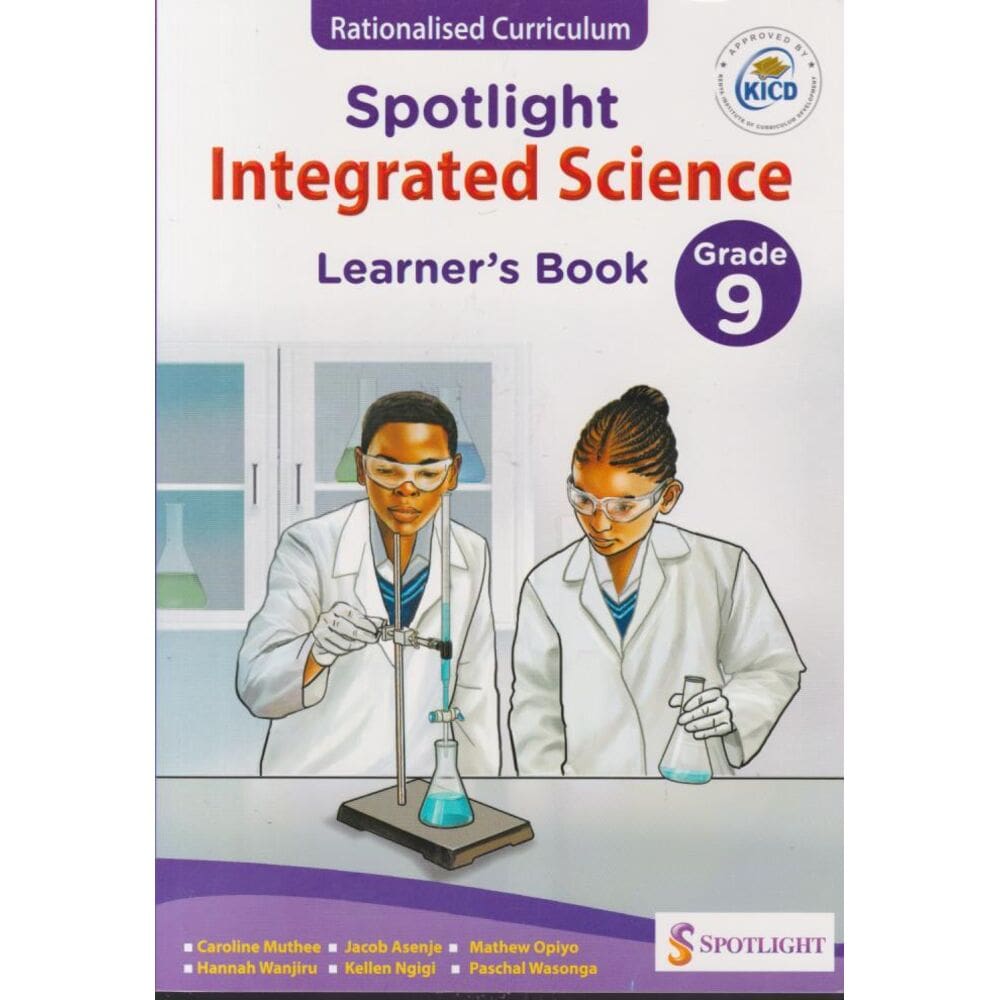
It is a learner’s book built for Grade 9 under the current Competency-Based Curriculum (CBC) in Kenya.

It’s meant to give a broad, foundational introduction to science β€” not just one branch (like biology or physics), but an integrated survey across multiple disciplines: biology, chemistry, physics, and health science.

🎯 Purpose & Educational Approach

The book aims to:

Help learners build scientific knowledge, problem-solving skills, and scientific literacy that they can apply in everyday life and future studies.

Encourage inquiry-based learning (asking questions, doing experiments, observing results, analyzing) β€” not just memorizing facts.

Promote critical thinking, creativity, and innovation, by having learners do experiments, investigations, projects, and real-life application tasks.

Integrate cross-cutting themes beyond science: environmental awareness, ICT (digital literacy), and even entrepreneurship, linking science to real-world contexts.

Offer a learner-friendly format: explanations illustrated with diagrams, charts, and photographs; plus a mix of class activities, homework projects, and self-assessment exercises.

✏️ What’s Inside β€” Typical Topics & Structure

While topics may vary slightly by syllabus edition, typical content includes:

Living things and their environment β€” nutrition in plants, photosynthesis, reproduction in plants, seed/fruit dispersal, ecology, energy flow, food chains/webs.

Basic biology and ecosystems β€” classification of organisms, interdependence of life, symbiosis, parasitism, saprophytism.

Fundamental chemistry β€” matter, mixtures, chemical reactions, maybe periodic table and basic chemical concepts (though detailed chemistry comes later). The integrated design means chemistry is introduced alongside biology and physics.

Basic physics/physical science β€” energy, matter, possibly concepts related to physical phenomena and forces (since Integrated Science spans physical world understanding).

Health science and everyday science applications β€” hygiene, sanitation, nutrition, environmental conservation, and using science knowledge for real-life wellbeing and sustainability.

Each section tends to include: explanations + illustrations, practical experiments or investigations, group work or project work, self-assessment or class assessment tasks.

πŸ“ˆ Why It Matters

It lays the foundation for STEM pathways at senior school level β€” giving learners strong grounding before they specialize.

It fosters a scientific mindset: curiosity, critical thinking, problem-solving, and evidence-based decision making β€” useful beyond school, in everyday life.

By integrating ICT, environment and entrepreneurship themes, it bridges school science with real-world challenges β€” preparing learners to apply science creatively and responsibly.
It is a learner’s book built for Grade 9 under the current Competency-Based Curriculum (CBC) in Kenya.

It’s meant to give a broad, foundational introduction to science β€” not just one branch (like biology or physics), but an integrated survey across multiple disciplines: biology, chemistry, physics, and health science.

🎯 Purpose & Educational Approach

The book aims to:

Help learners build scientific knowledge, problem-solving skills, and scientific literacy that they can apply in everyday life and future studies.

Encourage inquiry-based learning (asking questions, doing experiments, observing results, analyzing) β€” not just memorizing facts.

Promote critical thinking, creativity, and innovation, by having learners do experiments, investigations, projects, and real-life application tasks.

Integrate cross-cutting themes beyond science: environmental awareness, ICT (digital literacy), and even entrepreneurship, linking science to real-world contexts.

Offer a learner-friendly format: explanations illustrated with diagrams, charts, and photographs; plus a mix of class activities, homework projects, and self-assessment exercises.

✏️ What’s Inside β€” Typical Topics & Structure

While topics may vary slightly by syllabus edition, typical content includes:

Living things and their environment β€” nutrition in plants, photosynthesis, reproduction in plants, seed/fruit dispersal, ecology, energy flow, food chains/webs.

Basic biology and ecosystems β€” classification of organisms, interdependence of life, symbiosis, parasitism, saprophytism.

Fundamental chemistry β€” matter, mixtures, chemical reactions, maybe periodic table and basic chemical concepts (though detailed chemistry comes later). The integrated design means chemistry is introduced alongside biology and physics.

Basic physics/physical science β€” energy, matter, possibly concepts related to physical phenomena and forces (since Integrated Science spans physical world understanding).

Health science and everyday science applications β€” hygiene, sanitation, nutrition, environmental conservation, and using science knowledge for real-life wellbeing and sustainability.

Each section tends to include: explanations + illustrations, practical experiments or investigations, group work or project work, self-assessment or class assessment tasks.

πŸ“ˆ Why It Matters

It lays the foundation for STEM pathways at senior school level β€” giving learners strong grounding before they specialize.

It fosters a scientific mindset: curiosity, critical thinking, problem-solving, and evidence-based decision making β€” useful beyond school, in everyday life.

By integrating ICT, environment and entrepreneurship themes, it bridges school science with real-world challenges β€” preparing learners to apply science creatively and responsibly.

SKU: 9789966574077
Category:

Customer Reviews

There are no reviews yet.

Be the first to review “spotlight integrated science grade 9”

Your email address will not be published. Required fields are marked *