
In 2000, Daniel Suelo left his life savings-all thirty dollars of it-in a phone booth. He has lived without money-and with a newfound sense of freedom and security-ever since. The Man Who Quit Money is an account of how one man learned to live, sanely and happily, without earning, receiving, or spending a single cent. Suelo doesn’t pay taxes, or accept food stamps or welfare. He lives in caves in the Utah canyonlands, forages wild foods and gourmet discards. He no longer even carries an I.D. Yet he manages to amply fulfill not only the basic human needs-for shelter, food, and warmth-but, to an enviable degree, the universal desires for companionship, purpose, and spiritual engagement. In retracing the surprising path and guiding philosophy that led Suelo into this way of life, Sundeen raises provocative and riveting questions about the decisions we all make, by default or by design, about how we live-and how we might live better.
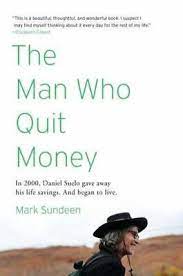
The Man Who Quit Money Paperback
KSh 1,000.00
In 2000, Daniel Suelo left his life savings-all thirty dollars of it-in a phone booth. He has lived without money-and with a newfound sense of freedom and security-ever since. The Man Who Quit Money is an account of how one man learned to live, sanely and happily, without earning, receiving, or spending a single cent. Suelo doesn’t pay taxes, or accept food stamps or welfare. He lives in caves in the Utah canyonlands, forages wild foods and gourmet discards. He no longer even carries an I.D. Yet he manages to amply fulfill not only the basic human needs-for shelter, food, and warmth-but, to an enviable degree, the universal desires for companionship, purpose, and spiritual engagement. In retracing the surprising path and guiding philosophy that led Suelo into this way of life, Sundeen raises provocative and riveting questions about the decisions we all make, by default or by design, about how we live-and how we might live better.
1 in stock
| Author | Mark Sundeen |
|---|
Customer Reviews
There are no reviews yet.
Related products
-
Reading and Understanding Research
KSh 10,500.00Ideal for students, novice researchers, or professionals, this indispensable resource serves as a road map for readers who need to analyze and apply research findings. It helps them think critically about the credibility of what they are reading by showing them how to identify problems and develop constructive questions.
Key Features
- Assumes no prior knowledge of research procedures
- Provides readers with a step-by-step format for decoding the complex language and formats used in reports and reviews
- Includes the most common formats for both quantitative and qualitative inquiry
- Offers both illustrative examples and powerful training exercises
- Gives specific attention to strategies for critically appraising reported research
- Presents completely updated references as well as an annotated bibliography
Intended Audience
This text is appropriate for both upper-level undergraduate and graduate students across the social sciences enrolled in introductory research courses as well as students in professional preparation programs.
-
Psychology: The Science of Mind and Behaviour 4e
KSh 8,960.00Psychology: The Science of Mind and Behaviour fourth edition has been fully updated to reflect new developments in the field. Its celebrated pedagogical design has been reinforced with key research, issues and offers an exciting and engaging introduction to the study of psychology.The scientific approach brings together international research, practical application and the levels of analysis framework to encourage critical thinking about psychology and its impact on our daily lives. Key features:•Brand new! Psychology at Work interviews from Psychologists in the field provide a glimpse of their day-to-day work and the career path they have taken since completing a psychology degree. •Research Close Ups reflect new research and literature as well as brand new critical thinking questions to increase analysis and evaluation of the findings. •Core subject updates such as DSM-5 for psychological disorders. •Current issues and hot topics such as, social media, prosociality, critical perspectives of positive psychology and coverage of the replication crisis to prompt debates on the questions facing psychologists today.•Focus Arrow Boxes encourage critical analysis and application of the text.
-

Textbook of Global Child Health, 2nd Edition
KSh 9,562.00The second edition of the American Academy of Pediatrics Textbook of Global Child Health is pleased to contribute toward international efforts to improve the lives of the next generation. This new edition will help prepare and support child health professionals as they join international efforts on behalf of children.
A large multinational team of authors has joined together to produce the 2nd edition of this award-winning textbook, which focuses on 3 key areas:
- Foundational understanding of societal factors related to health and disease
- Appropriate care of children traveling internationally
- Clinical management of children in resource-limited areas
New in the 2nd edition:
- 29 updated chapters and sections
- New chapters on cardiology, neurologic disorders, nephrology, emergency medicine and critical care, and hematology/oncology
-

The Ethnographic Imagination
KSh 1,200.00In this book Paul Willis, a renowned sociologist and ethnographer, aims to renew and develop the ethnographic craft across the disciplines. Drawing from numerous examples of his own past and current work, he shows that ethnographic practice and the ethnographic imagination are vital to understanding the creativity and irreducibility of experience in all aspects of social and cultural practice.
Willis argues that ethnography plays a vital role in constituting ‘sensuousness’ in textual, methodological, and substantive ways, but it can do this only through the deployment of an associated theoretical imagination which cannot be found simply there in the field. He presents a bold and incisive ethnographically oriented view of the world, emphasizing the need for a deep-running social but also aesthetic sensibility. In doing so he brings new insights to the understanding of human action and its dialectical relation to social and symbolic structures. He makes original contributions to the understanding of the contemporary human uses of objects, artefacts and communicative forms, presenting a new analysis of commodity fetishism as central to consumption and to the wider social relations of contemporary societies. He also utilizes his perspective to further the understanding of the contemporary crisis in masculinity and to cast new light on various lived everyday cultures – at school, on the dole, on the street, in the Mall, in front of TV, in the dance club.
This book will be essential reading for all those involved in planning or contemplating ethnographic fieldwork and for those interested in the contributions it can make to the social sciences and humanities.
-

District Laboratory Practice in Tropical Countries
KSh 21,240.00This new edition includes an update on HIV disease/AIDS, recently developed HIV rapid tests to diagnose HIV infection and screen donor blood, and current information on antiretroviral drugs and the laboratory monitoring of antiretroviral therapy. Information on the epidemiology and laboratory investigation of other pathogens has also been brought up to date. Several new, rapid, simple to perform immunochromatographic tests to assist in the diagnosis of infectious diseases are described, including those for brucellosis, cholera, dengue, leptospirosis, syphilis and hepatitis. Recently developed lgM antibody tests to investigate typhoid fever are also described. The new classification of salmonellae has been introduced. Details of manufacturers and suppliers now include website information and e-mail addresses. The haematology and blood transfusion chapters have been updated, including a review of haemoglobin measurement methods in consideration of the high prevalence of anaemia in developing countries.
-

Tess of the D’Urbervilles
KSh 650.00Young Tess Durbeyfield attempts to restore her family’s fortunes by claiming their connection with the aristocratic d’Urbervilles. But Alec d’Urberville is a rich wastrel who seduces her and makes her life miserable. When Tess meets Angel Clare, she is offered true love and happiness, but her past catches up with her and she faces an agonizing moral choice. Thomas Hardy’s indictment of society’s double standards, and his depiction of Tess as “”a pure woman,”” caused controversy in his day and has held the imagination of readers ever since. Hardy thought it his finest novel and Tess the most deeply felt character he ever created.
-
Information Governance and Assurance: Reducing risk, promoting policy
KSh 10,780.00This comprehensive textbook discusses the legal, organizational and ethical aspects of information governance and assurance and security and their relevance to all aspects of information work.
Information governance describes the activities and practices which have developed to control the use of information, including, but not limited to, practices mandated by law. In a world in which information is increasingly seen as a top-level asset, the safeguarding and management of information is of concern to everyone. From the researcher who is responsible for ethical practices in the gathering, analysis, and storage of data, to the reference librarian who must deliver unbiased information; from the records manager who must respond to information requests, to the administrator handling personnel files, this book with equip practitioners and students alike to implement good information governance practice in real-world situations.
Key topics covered include:
Information as an asset
The laws and regulations
Data quality management
Dealing with threats
Security, risk management and business continuity
Frameworks, policies, ethics and how it all fits together.
Readership: Fully supported by examples, discussion points and practical exercises, this is essential reading for everyone who needs to understand, implement and support information assurance policies and information governance structures. It will be particularly valuable for LIS students taking information management and information governance courses, and information professionals with an advisory or gatekeeping role in information governance within an organization.
-

The Autobiography of Malcolm X
KSh 1,695.00Malcolm X’s The Autobiography of Malcolm X was written in collaboration with Alex Haley, author of Roots, and includes an introduction by Paul Gilroy, author of The Black Atlantic, in Penguin Modern Classics.
From hustling, drug addiction and armed violence in America’s black ghettos Malcolm X turned, in a dramatic prison conversion, to the puritanical fervour of the Black Muslims. As their spokesman he became identified in the white press as a terrifying teacher of race hatred; but to his direct audience, the oppressed American blacks, he brought hope and self-respect. This autobiography (written with Alex Haley) reveals his quick-witted integrity, usually obscured by batteries of frenzied headlines, and the fierce idealism which led him to reject both liberal hypocrisies and black racialism.
Vilified by his critics as an anti-white demagogue, Malcolm X gave a voice to unheard African-Americans, bringing them pride, hope and fearlessness, and remains an inspirational and controversial figure.
Malcolm X (1925-65), born Malcolm Little in Omaha, and also known as El-Hajj Malik El-Shabazz, lost both his parents at a young age. Leaving school early, he soon became part of Harlem’s underworld, and in 1946 he was sentenced to ten years’ imprisonment. It was in prison that Malcolm X converted to Islam. Paroled in 1952, he became an outspoken defender of Muslim doctrines, formed the Organization of Afro-American Unity in 1963, and had received considerable publicity by the time of his assassination in 1965.
If you enjoyed The Autobiography of Malcolm X, you might like Nelson Mandela’s No Easy Walk to Freedom, also available in Penguin Modern Classics.
‘This extraordinary autobiography is a brilliant, painful, important book’
The New York Times
Be the first to review “The Man Who Quit Money Paperback”