
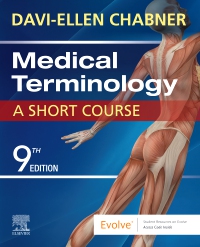
Build a working medical vocabulary quickly with Chabner’s Medical Terminology: A Short Course, 9th Edition! Omitting time-consuming, nonessential information, this text helps you master the basics of medical vocabulary — including the most frequently encountered suffixes, prefixes, and word roots. A text/workbook format lets you practice and interact with medical terminology on almost every page through exercises, labeling, and pronunciations. Case studies and real-world vignettes demonstrate how medical terms are used in practice. With all this plus medical animations, word games, and flash cards on the Evolve website, you’ll be amazed at how easily medical terminology becomes part of your vocabulary.
Medical Terminology: A Short Course, 9th Edition
KSh 11,100.00
Build a working medical vocabulary quickly with Chabner’s Medical Terminology: A Short Course, 9th Edition! Omitting time-consuming, nonessential information, this text helps you master the basics of medical vocabulary — including the most frequently encountered suffixes, prefixes, and word roots. A text/workbook format lets you practice and interact with medical terminology on almost every page through exercises, labeling, and pronunciations. Case studies and real-world vignettes demonstrate how medical terms are used in practice. With all this plus medical animations, word games, and flash cards on the Evolve website, you’ll be amazed at how easily medical terminology becomes part of your vocabulary.
1 in stock
Customer Reviews
There are no reviews yet.
Related products
-
Medical Microbiology, International Edition, 19th Edition
KSh 7,462.00Medical microbiology concerns the nature, distribution and activities of microbes and their impact on health and wellbeing. In spite of the introduction of many antimicrobial agents and immunisations, we continue to face major challenges in combatting infection, not least the gathering crisis in antimicrobial resistance.
Now in a fully revised and updated 19th edition, Medical Microbiology provides comprehensive coverage of infection from the microbial perspective, combining a clear introduction to key principles with a focus explicitly geared to modern clinical practice. It provides ideal coverage for medical and biomedical students – with ‘Key Points’ boxes throughout to highlight the essentials – and sufficient detail to also inform specialists in training.
Building on the success of previous editions, updates in Medical Microbiology 19e include:
-
- New and expanded coverage of hot topics and emerging areas important to clinical practice, including:
-
-
- Genomics
-
-
-
- The Human Microbiome
-
-
-
- Direct acting antiviral agents for the treatment of HCV infection
-
-
-
- Molecular methods in diagnostic microbiology
-
-
-
- Antibiotic Stewardship
-
-
- BONUS electronic materials to enhance your learning, including:
-
-
- Clinical cases – to introduce how patients with infections present and help relate key principles to practice
-
-
- MCQs for each chapter – to check understanding and aid exam preparation
-
-
Miller’s Basics of Anesthesia, 8th Edition
KSh 14,700.00Long regarded as the undisputed leading text of its kind, Miller’s Basics of Anesthesia provides comprehensive yet concise coverage of both basic science and clinical topics in anesthesiology. Under the experienced editorial leadership of Dr. Manuel C. Pardo, Jr., the 8th Edition has been meticulously updated to reflect the latest advances in practice and important aspects of contemporary anesthesia care, including pathophysiology, pharmacology, regional anesthesia, anesthetic management, and special problems and patient groups. It remains the first learning resource of choice for anesthesia providers, including anesthesia residents and fellows, medical students, and student registered nurse anesthetists, and is also a valuable review tool for practitioners undergoing maintenance of certification or recertification.
-
The Great Influenza: The Story of the Deadliest Pandemic in History -Paperback
KSh 650.00Magisterial in its breadth of perspective and depth of research, The Great Influenza provides us with a precise and sobering model as we confront the epidemics looming on our own horizon. As Barry concludes, “The final lesson of 1918, a simple one yet one most difficult to execute, is that…those in authority must retain the public’s trust. The way to do that is to distort nothing, to put the best face on nothing, to try to manipulate no one. Lincoln said that first, and best. A leader must make whatever horror exists concrete. Only then will people be able to break it apart.”
At the height of World War I, history’s most lethal influenza virus erupted in an army camp in Kansas, moved east with American troops, then exploded, killing as many as 100 million people worldwide. It killed more people in twenty-four months than AIDS killed in twenty-four years, more in a year than the Black Death killed in a century. But this was not the Middle Ages, and 1918 marked the first collision of science and epidemic disease.
-

An Introduction to Forensic Genetics, 2nd Edition
KSh 16,198.00This is a completely revised edition of a comprehensive and popular introduction to the fast moving area of Forensic Genetics. The text begins with key concepts needed to fully appreciate the subject and moves on to examine the latest developments in the field. Now illustrated in full colour throughout, this accessible textbook includes numerous references to relevant casework. With information on the full process of DNA evidence from collection at the scene of a crime to presentation in a legal context this book provides a complete overview of the field.
Key Features:
- Greater in-depth coverage of kinship problems now covered in two separate chapters: one dealing with relationships between living individuals and the other covering identification of human remains.
- New chapter on non-human forensic genetics, including identification of bacteria and viruses, animals and plants.
-
Guyton and Hall Textbook of Medical Physiology, International Edition, 14th Edition
KSh 13,300.00Known for its clear presentation style, single-author voice, and focus on content most relevant to clinical and pre-clinical students, Guyton and Hall Textbook of Medical Physiology, 14th Edition, employs a distinctive format to ensure maximum learning and retention of complex concepts. A larger font size emphasizes core information, while supporting information, including clinical examples, are detailed in smaller font and highlighted in pale blue – making it easy to quickly skim the essential text or pursue more in-depth study. This two-tone approach, along with other outstanding features, makes this bestselling text a favorite of students worldwide.Key Features-
- Offers a clinically oriented perspective written with the clinical and preclinical student in mind, bridging basic physiology with pathophysiology.
- Focuses on core material and how the body maintains homeostasis to remain healthy, emphasizing the important principles that will aid in later clinical decision making.
- Presents information in short chapters using a concise, readable voice that facilitates learning and retention.
- Contains more than 1,200 full-color drawings and diagrams – all carefully crafted to make physiology easier to understand.
- Features expanded clinical coverage including obesity, metabolic and cardiovascular disorders, Alzheimer’s disease, and other degenerative diseases.
- Includes online access to interactive figures, new audio of heart sounds, animations, self-assessment questions, and more.
- Enhanced eBook version included with purchase. Your enhanced eBook allows you to access all of the text, figures, and references from the book on a variety of devices.
-
-
Integrative Human Biochemistry: A Textbook for Medical Biochemistry
KSh 13,750.00This book covers in detail the mechanisms for how energy is managed in the human body. The basic principles that elucidate the reactivity and physical interactions of matter are addressed and quantified with simple approaches. Three-dimensional representations of molecules are presented throughout the book so molecules can be viewed as unique entities in their shape and function.
The book is focused on the molecular mechanisms of cellular processes in the context of human physiological situations such as fasting, feeding and physical exercise, in which metabolic regulation is highlighted. Furthermore the book uses key historical experiments that opened up new concepts in Biochemistry to further illustrate how the human body functions at molecular level, helping students to appreciate how scientific knowledge emerges.
This book also:
- Elucidates the foundations of the molecular events of life
Uses key historical experiments that opened up new concepts in Biochemistry to further illustrate how the human body functions at molecular level, helping students to appreciate how scientific knowledge emerges
- Provides realistic representations of molecules throughout the book
Advance Praise for Integrative Human Biochemistry
“This textbook provides a modern and integrative perspective of human biochemistry and will be a faithful companion to health science students following curricula in which this discipline is addressed. This textbook will be a most useful tool for the teaching community.”
- Elucidates the foundations of the molecular events of life
-
Netter’s Clinical Skills, 1st Edition
KSh 3,080.00Make the most of every patient encounter – from the clinical interview and history to the physical exam, both in-office and bedside. This discreet quick reference by Ilene L. Rosenberg, MD, FCCP, Todd Cassese, MD, FACP, and Dennis Barbon, RN, helps you achieve consistent and comprehensive results when collecting data and determining your next steps. Carry this thin, fully illustrated checklist in your white coat pocket for the fastest, most efficient way to access essential information you need to know and remember every day.
-
Muir’s Textbook of Pathology
KSh 3,800.00First published in 1924, Muir’s Textbook of Pathology has set a standard in this subject by linking the scientific aspects that underlie pathological processes, relating these pathological changes specific to the various organ systems, and placing all in context for the student of clinical
medicine and surgery. Subsequent editions have retained this popular approach, while introducing novel concepts and taking into account the evolution in the teaching of general pathology that has occurred.This fully-revised 14th edition will ensure that the title retains its preeminence in the field with a clearly defined and easy-to-follow structure, new photographs and explanatory line diagrams, all in full color, and applicability to both systems-based and problem-based undergraduate courses.
Focusing on core material without neglecting up-to-the-minute detail, this book is a key text for students, but also has significant appeal for pathology residents.
Be the first to review “Medical Terminology: A Short Course, 9th Edition”